
Protein Labeling Reagents


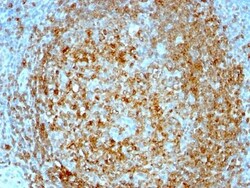
Biotium CD74(BU45), CF488A conjugate, 0.1mg/mL
Recognizes proteins of 33, 35 and 41 kDa, which are identified as various isoforms of CD74. Its epitope is localized in the extracellular domain of CD74. CD74 is a type II transmembrane protein which binds to the peptide binding groove of newly synthesized MHC class II alpha/beta heterodimers and prevents their premature association with endogenous polypeptides. The CD74 molecule plays a critical role in the presentation of peptides, by the MHC class II antigens, to CD4 positive lymphocytes. CD74 is expressed on MHC class II positive cells including B cells, a subset of activated T cells, monocytes, and dendritic cells and by various types of carcinomas. CD74 is expressed primarily by antigen presenting cells, such as B-lymphocytes (from before the pre-B cell stage to before the plasma cell stage), macrophages, and monocytes, and many epithelial cells. Anti-CD74 stains predominantly germinal center lymphocytes and B-cell lymphomas, but rarely T-cell lymphomas. Anti-CD74 has b

Biotium CD25(143-13), CF488A conjugate, 0.1mg/mL
Recognizes a protein of 55 kDa, identified as CD25 (Workshop IV; Code A27). CD25 is expressed on activated T- and B-cells and activated monocytes/macrophages. With respect to lymphomas, CD25 is present on malignant cells of Hodgkin's disease, HTLV-1 adult T-cell leukemia, cutaneous T-cell lymphoma, and hair cell leukemia. Increased levels of soluble CD25 are observed in the leukemias/lymphomas and inflammatory/ autoimmune diseases. CD25 molecule alone appears to function as a low affinity receptor and associates with CD122 (IL-2R beta chain, p75) and CD132 (common gamma chain) to form the high affinity IL-2 receptor complex. CD25 antibodies detect three epitope regions, A, B and C. This MAb recognizes the epitope B, which is located at residue 3-104 of CD25 and can effectively block IL-2 binding to CD25.Primary antibodies are available purified, or with a selection of fluorescent CF Dyes and other labels. CF Dyes offer exceptional brightness and photostability. Note: Con
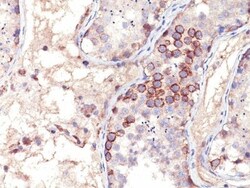
Biotium MAGE A1(MA454), CF568 conjugate, 0.1mg/mL
Recognizes a protein of 42-46 kDa, identified as MAGE-1. This MAb does not cross-react with MAGE-2, -3, -4, -6 -9, -10, -or -12 protein. Human malignant neoplasms carry rejection antigens that are recognized by the patients' autologous, tumor directed and specific, cytolytic, CD8 T lymphocyte clones (CTL). The MAGE family of genes codes an important group of antigens. It was identified that melanomas and primary glial brain tumors express common melanoma associated antigens (MAAs). Because MAGE-1 is expressed on a significant proportion of human neoplasms of various histological types (melanoma, brain tumors of glial origin, neuroblastoma, non-small cell lung cancer, breast, gastric, colorectal, ovarian, renal cell carcinomas) and not on normal tissues, the encoded antigen may serve as a marker of early detection and target for cancer immunotherapy.Primary antibodies are available purified, or with a selection of fluorescent CF Dyes and other labels. CF Dyes offer excepti

Biotium CF633 Hydrazide
Our CF dye hydrazides are bright, extremely water-soluble and nontoxic. These properties make the dyes excellent fixable polar tracers for microinjection into cells. Hydrazides also can be used for labeling aldehyde or ketone groups, however, for this application we recommend using the more reactive CF dye aminooxy forms. CF dyes are Biotium's line of next-generation fluorescent dyes with advantages in brightness, photostability, and conjugate specificity compared to other fluorescent dyes. Far-red fluorescent CF633 dye has excitation/emission at 630/650 nm.
Biotium CD2(1E7E8.G4), CF488A conjugate, 0.1mg/mL
CD2 interacts through its amino-terminal domain with the extracellular domain of CD58 (also designated CD2 ligand) to mediate cell adhesion. CD2/CD58 binding can enhance antigen-specific T cell activation. CD2 is a transmembrane glycoprotein that is expressed on peripheral blood T lymphocytes, NK cells and thymocytes. CD58 is a heavily glycosylated protein with a broad tissue distribution in hematopoietic and other cells, including endothelium. Interaction between CD2 and its counter receptor LFA3 (CD58) on opposing cells optimizes immune system recognition, thereby facilitating communication between helper T lymphocytes and antigen-presenting cells, as well as between cytolytic effectors and target cells.Primary antibodies are available purified, or with a selection of fluorescent CF Dyes and other labels. CF Dyes offer exceptional brightness and photostability. Note: Conjugates of blue fluorescent dyes like CF405S and CF405M are not recommended for detecting low abunda

Biotium Tyramide Amplification Kit with HRP Streptavidin and CF543 Tyramide
Tyramide amplification, sometimes called Catalyzed Reporter Deposition (CARD), is an enzyme-mediated detection method that uses the catalytic activity of horseradish peroxidase (HRP) to generate high density labeling of a target protein or nucleic acid sequence in situ. The tyramide amplification method has been reported to increase the sensitivity by up to 100-fold compared to the conventional avidin-biotinylated complex procedure. The kit contains HRP goat anti-mouse CF543 dye tyramide. The dye has an excitation/emission of 541/560 nm. The kit contains sufficient reagent for 50-150 slides.
Biotium MALT-1(MT1/410), CF568 conjugate, 0.1mg/mL
Mucosa associated lymphoid tissue lymphoma translocation gene 1 (MALT1) is found in extranodal low-grade B cell lymphomas. MALT1 encodes two Ig-like C2-type domains and fuses with an API2 gene, which is highly expressed in adult lymphoid tissue. The translocation of this MALT1 gene, which maps to human chromosome 18q21, and the apoptosis-inhibiting API2 gene results in an increased development of MALT lymphomas and apoptosis inhibition. Sites at which this API2-MALT1 (11;18)(q21;q21) translocation commonly occurs are within human lung and kidney tissue. MALT lymphoma expresses nuclear Bcl10, which mediates the oligomerization and activation of a MALT1 caspase-like domain. MALT1 mRNA is found in pre-B cells, mature B cells and plasma cells.Primary antibodies are available purified, or with a selection of fluorescent CF Dyes and other labels. CF Dyes offer exceptional brightness and photostability. Note: Conjugates of blue fluorescent dyes like CF405S and CF405M are not re
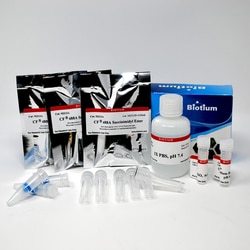
Biotium CF405S Protein Labeling Kit , 3x(1mg) labelings
This kit contains everything you need to label antibodies or other proteins with a fluorescent CF dye succinimidyl ester (CF dye SE). Each kit contains reagents for three labeling reactions of up to 1 mg protein per reaction. CF dyes are Biotium's line of next-generation fluorescent dyes with advantages in brightness, photostability, and conjugate specificity compared to other fluorescent dyes. Blue fluorescent CF405S dye has excitation/emission at 404/431 nm.
Biotium CF568 Biocytin
Fluorescent biocytin conjugates are cell-impermeant, fixable polar tracers with biotin and an aldehyde-fixable primary amine groups. Polar tracers are commonly used to investigate cell-cell and cell-liposome fusion as well as membrane permeability and transport through gap junctions or cell uptake during pinocytosis. CF dyes are Biotium's line of next-generation fluorescent dyes with advantages in brightness, photostability, and conjugate specificity compared to other fluorescent dyes. Red fluorescent CF568 dye has excitation/emission at 562/583 nm.
Biotium CD55 (DAF)(143-30), CF568 conjugate, 0.1mg/mL
Recognizes a single chain glycoprotein of 70 kDa, identified as CD55 (also known as decay accelerating factor, DAF). CD55/DAF is widely expressed on cells throughout the body including leukocytes, erythrocytes, epithelium, endothelium, and fibroblasts. It is a Glycosyl phosphatidylinositol anchored (GPI-anchored) member of the membrane bound complement regulatory proteins that inhibit autologous complement cascade activation. It prevents the amplification steps of the complement cascade by interfering with the assembly of the C3-convertases, C4b2a and C3bBb, and the C5-convertase, C4b2a3b and C3bBb3b. CD55 also serves as receptor for CD97 and for echovirus and Coxsackie B virus. The MAb 143-30 can be used as marker for paroxysmal nocturnal hemoglobinuria (PNH).Primary antibodies are available purified, or with a selection of fluorescent CF Dyes and other labels. CF Dyes offer exceptional brightness and photostability. Note: Conjugates of blue fluorescent dyes like CF405

Biotium 5(6)-CARBOXYRhodamine 110-C5-Maleimide (
CR110-C5-maleimide (full name: 5(6)-Carboxyrhodamine 110-C5-maleimide) is a maleimide derivative of the green fluorescent dye carboxyrhodamine 110. The dye has spectral properties (Ex/Em (MeOH) = 502/524 nm) similar to those of fluorescein (fluorescein-5-maleimide, for example), but the photostability of the dye is among the best of all green fluorescent dyes. Thus, the dye is a superior green fluorescent dye for labeling thiols. Properties: Orange red solid soluble in DMF or DMSO; Store at -20°C and protect from light, especially in solution; C31H30N4O6; MW: 554.59.
Biotium CD30(CD30/412), CF488A conjugate, 0.1mg/mL
Recognizes a single chain glycoprotein of 105/120 kDa, identified as CD30/Ki-1. CD30 is synthesized as a 90 kDa precursor, which is processed in the Golgi complex into a membrane-bound phosphorylated mature 105/120 kDa glycoprotein. In Hodgkin's disease, CD30/Ki-1 antigen is expressed by mononuclear-Hodgkin and multinucleated Reed-Sternberg cells. It is also expressed by the tumor cells of a majority of anaplastic large cell lymphomas as well as by a varying proportion of activated T and B cells. This MAb distinguishes large cell lymphomas derived from activated lymphoid cells from histiocytic malignancies and lymphomas derived from resting and precursor lymphoid cells or from anaplastic carcinomas. About one third of the Ki-1 positive lymphomas lack the leukocyte common antigen (CD45).Primary antibodies are available purified, or with a selection of fluorescent CF Dyes and other labels. CF Dyes offer exceptional brightness and photostability. Note: Conjugates of blue fl
ABclonal Technology Cleaved Gasdermin DGly276

Gasdermin D is a member of the gasdermin family Members of this family appear to play a role in regulation of epithelial proliferation Gasdermin D has been suggested to act as a tumor suppressor Alternatively spliced transcript variants have been described